



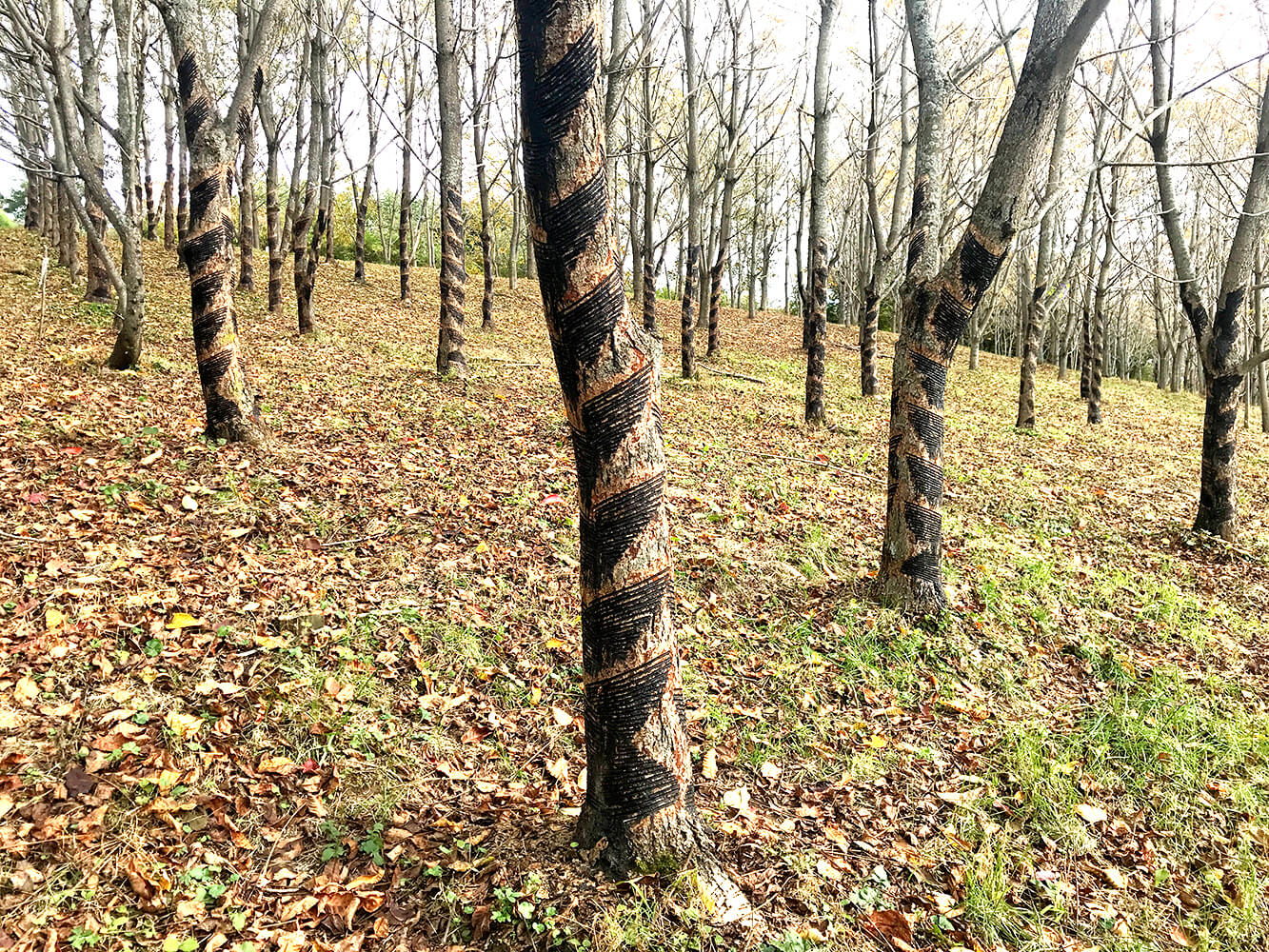
L’urushi is a natural plant-based lacquer native to Asia, made by refining the sap of the lacquer tree.
In Japan, it has been used since the Jōmon period, making it a material deeply rooted in history.
The bark of lacquer trees, which are cultivated for more than ten years, is carefully incised by skilled artisans known as urushikaki.
Through their highly refined techniques, the sap is collected little by little.
It is not a resource that can be obtained in large quantities at once — it is a precious material, harvested with time and great care.
Freshly collected sap cannot be used as it is.
Only after undergoing transformation processes known as nayashi and kurome does it become a usable lacquer.
The characteristics of L’urushi
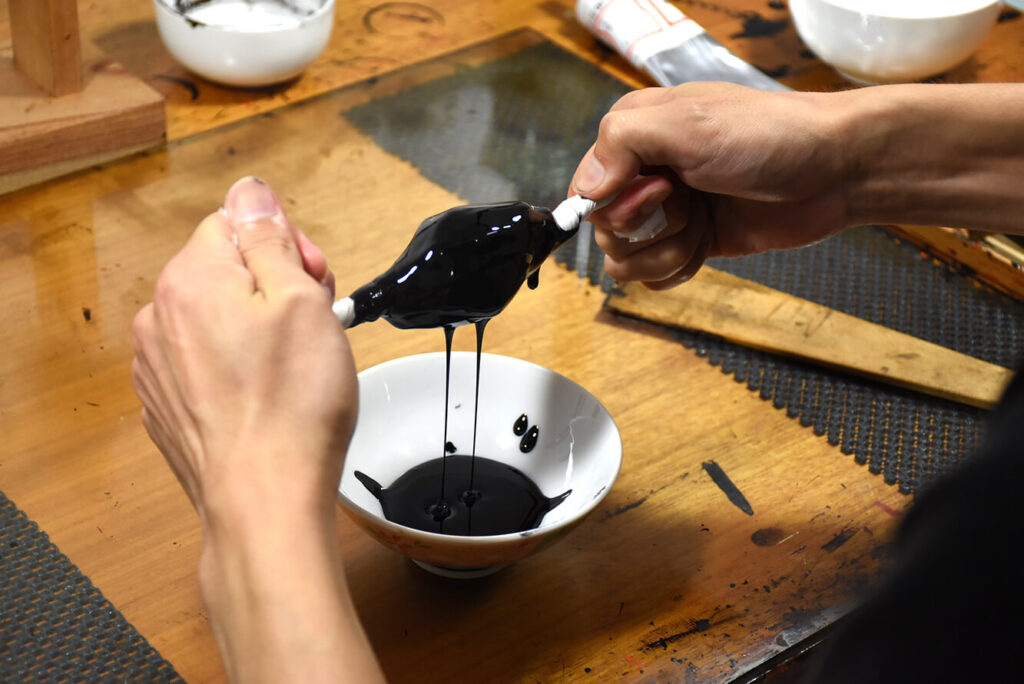
The main characteristic of L’urushi lies in the way it dries.
Unlike conventional paints that dry in air, L’urushi hardens in a humid environment, with a humidity level of around 70–80%, through the action of oxygen and enzymes.
This unique mechanism creates an extremely durable coating.
• Resistant to water and heat
• Resistant to acids and alkalis
• Naturally antibacterial
Thanks to these qualities, L’urushi is particularly suited for objects meant to last, such as tableware, furniture, as well as temples and shrines.
Once fully cured, L’urushi forms a very strong coating.
This layer is not only resistant to acids and alkalis, but also has antibacterial properties, making it a high-quality material.
In ancient Japan, L’urushi was even used for armor worn in battle.
Applied in multiple layers, it provided exceptional strength, capable of withstanding spears and swords, making it especially suitable for warfare.
L’urushi is an exceptionally precious natural material.
The amount of L’urushi that can be extracted from a single tree is only about 200 ml.
Moreover, the lacquer tree is cut down after harvesting, making it an extremely precious natural resource obtained through significant time and effort.
Today, most of the L’urushi used in Japan is imported, and domestically produced L’urushi is very rare.
Used not only for tableware but also for armor and furniture, L’urushi is a natural material that is both gentle on the body and extremely durable.
Passed down through centuries of Japanese tradition, L’urushi allows precious objects to be given new life.
Let us restore our most cherished pieces together with this exceptional material.
Kintsugi, a traditional Japanese art, is practiced using authentic L’urushi.
An essential point to understand when practicing kintsugi.
There are mainly two approaches:
• Traditional kintsugi, made using authentic L’urushi
• Simplified kintsugi, using synthetic adhesives
Simplified kintsugi has the advantage of being quick and easy to complete.
Since it does not use L’urushi, it does not cause skin reactions.
However, because it relies on synthetic glues, it is not suitable for objects intended for food use.
Today, many kintsugi workshops abroad offer simplified versions using adhesives.
This is because participants are expected to complete their piece on the same day, which makes it impossible to use real L’urushi.
In fact, L’urushi requires more than ten days to dry, and a complete process takes at least two months.
True traditional Japanese arts, such as maki-e and kintsugi, use authentic L’urushi.
While this requires time, the result is durable, safe for the body, and environmentally friendly.
In addition, the strength of L’urushi improves over time.
It is therefore important to clearly distinguish simplified kintsugi from traditional Japanese techniques using L’urushi.
Even today in Japan, there are specialized schools dedicated to training L’urushi artisans.
Students even learn to make their own tools, and it takes several years to become a true craftsman.
Another path is to apprentice under a master and acquire these techniques over time.
Authentic L’urushi is a natural material that is both safe and reliable.
Authentic L’urushi is a natural material.
When properly refined and fully cured, it can be safely used for tableware.
In addition, L’urushi has the unique quality of becoming stronger over time.
It is a material that evolves and reinforces itself through use, accompanying the object throughout its life.
It is essential to understand the difference between L’urushi and synthetic adhesives.
Even if they may appear similar, L’urushi and synthetic adhesives are completely different materials.
• Do you want to use the object as tableware?
• Or keep it simply as a decorative piece?
It is essential to choose the appropriate method based on its intended use.
A wrong choice can make the object unusable, even after repair.
Kintsugi is not just a repair, but a true rebirth.
Kintsugi is not simply a technique for repairing a broken object.
By combining L’urushi, cultivated over many years, with the work of human hands, it gives new value to the object.
In this way, it can continue to be used for many more years.
Drawing on the gifts of nature — gentle, strong, and beautifully refined — let us continue to cherish and give life to our most precious objects, for years to come.
Comments