



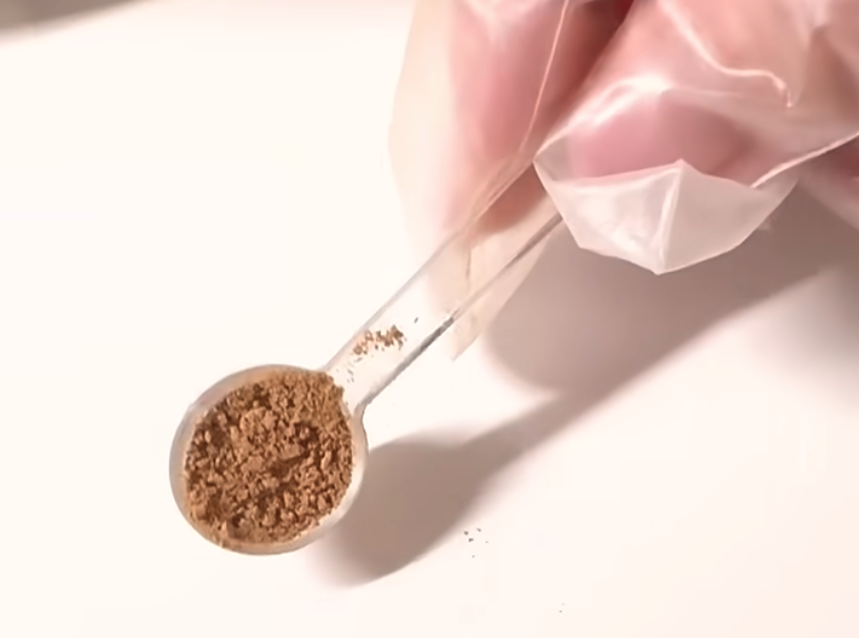
When taking out the powder, gently press it down before scooping.
Turn the powder into a finer texture. You can also sift it beforehand if needed.
※If there is too much water, gently press it with a tissue from above.
(Ratio: If tonoko powder is 10, use about 7–8 parts L’urushi.)
About 20 mixes are sufficient.
When it develops a glossy sheen while spreading with a spatula, it is ready.
Do not add L’urushi all at once—add it gradually in small amounts.
(Ratio: If tonoko powder is 10, use about 7–8 parts L’urushi.)
About 20 mixes are enough.
When a glossy sheen appears while spreading with a spatula, it is ready. Aim for a smooth, paste-like consistency.
Do not add L’urushi all at once; add it gradually in small amounts.
Spread it slightly on the working board and leave it for 1–2 minutes.
When the surface becomes slightly dark, it means there is enough urushi.
Then knead it again, and it’s finished!
What is sabi urushi?
Sabi urushi is a paste used in kintsugi to fill small chips, uneven surfaces, and gaps.
It is said to be named for its texture and color, which resemble iron rust.
It is mainly used to fill chips, but because it is fine and smooth, it is also used in the final stage of surface preparation.
Used in the following situations:
・Small chips
・Uneven surfaces
・Gaps
Points to note when making sabi urushi.
Measure the ratio of tonoko powder and urushi accurately.
If the proportions are off, the strength and durability may decrease, and it may not dry properly.
Using a small spoon or measuring tool can help.
Too much urushi: The sabi urushi will not harden easily, takes longer to dry, and may cause shrinkage.
Too little urushi: The strength of the sabi urushi will decrease.
If the sabi urushi does not dry after about two days, or if the surface shrinks, redo the process.
In that case, remove it with a cutter or similar tool and start again.
Sabi urushi darkens quickly when exposed to air.
Do not use any parts that have turned black and hardened—use only the soft material from the inside.
Tools and materials for making sabi urushi.
Tools
- Work board
- Mixing spatula
- Measuring spoon
- Gloves
Materials
- water
- Raw lacquer(Ki-urushi)
- tonoko
For cleaning
- Turpentine oil
- Tissues, paper towels, or cloths
How long does sabi urushi last?
About 1–2 days.
As time passes, it becomes harder to dry properly, so it is best to make only the amount you need.
It’s best to think of it as something that does not store well.
If there is any left, you can wrap it in plastic wrap to store it, but this is not recommended.
Comments