




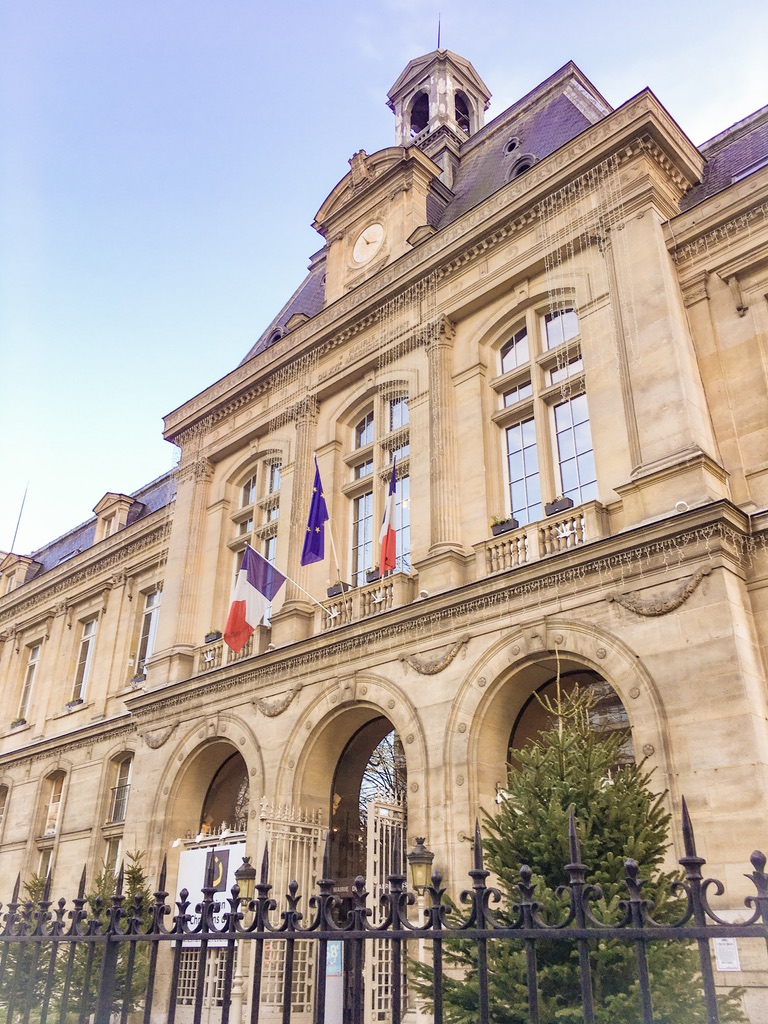
At that time, I was living in the 16th arrondissement of Paris and had just had a child.
One day, I happened to see a program on French television about maki-e, a traditional Japanese art.
The delicate patterns created on urushi lacquer.
The distinctive shimmer of gold and silver powders.
And above all, the extraordinary skills of the Japanese artisans who create these works.
I was deeply moved by the beauty of maki-e and the remarkable craftsmanship behind it. That was my very first encounter with urushi.
I have worked as a graphic designer since my early twenties. Today, in addition to graphic design, I also work with websites and social media, providing comprehensive branding support for people who want to develop their businesses in Paris.
I have always felt that, in a way, a designer is also a craftsperson.
Design is not a profession where learning ends once you have mastered a particular skill. You need to keep acquiring new knowledge and techniques, while constantly refining your sense of design as the world around you changes.
After working in design for many years, I have experienced countless moments when the smallest adjustment suddenly makes a design that had been missing something come alive.
Sometimes, the difference may be as little as 0.1 mm, almost imperceptible to the naked eye.
And yet, such a tiny adjustment can completely change the overall impression of a design.
After experiencing this again and again, I sometimes find myself thinking, “Perhaps this is where design enters the realm of craftsmanship.”
This may be one of the reasons why I have always had such deep respect for artisans who devote many years of their lives to mastering and refining a single craft.
Paris, where I lived for many years, is also a city with a strong culture of respect for artisans, their skills, and their craftsmanship.
And it was there, in Paris, that I discovered Japanese maki-e.
To me, the technique was extraordinarily beautiful. It seemed almost dazzling.
And the first thing I thought was:
“Why didn’t I learn maki-e when I was living in Japan?”
So I began searching for somewhere in France where I could study maki-e.
At the time, however, I could not find anywhere in France where I could truly learn traditional maki-e techniques.
Later, whenever I had the opportunity to return to Japan, I began visiting different places to deepen my understanding of maki-e and traditional urushi techniques. I visited universities and vocational schools, as well as artisans and artists who work with Japanese lacquer.
Through this blog, I would like to gradually share the places I have actually visited, what I have seen there, and what I have learned along the way.
I hope my experiences will be useful to those who would like to begin learning kintsugi or maki-e, as well as to anyone who would like to discover and understand the Japanese culture of urushi more deeply.
Comments